




Breaking News
latest sports updates

Football

Football

AYARI DOUBLE AND DYNAMIC DUO DISMANTLE TUNISIA IN MONTERREY

MONTERREY, Mexico — If there were lingering doubts about Sweden’s credentials following a stuttering qualifying campaign, they were emphatically silenced under the humid skies of Monterrey on Sunday. In a display of clinical transition football and individual brilliance, the Blågult dismantled Tunisia 5-1, signalling a tactical rebirth under Graham Potter that few saw coming. The seamless execution on the pitch was a testament to a team that appears transformed since qualifying. The evening belonged to Yasin Ayari. The Brighton midfielder, born to a Tunisian father, paid homage to his heritage with a brace of breathtaking quality. However, it was the sheer cumulative power of Sweden’s frontline—spearheaded by Alexander Isak and Viktor Gyokeres—that turned a competitive fixture into a rout. Not since the 1938 thrashing of Cuba has a Swedish side been this prolific on the world stage, and the manner of the victory suggests they are no longer merely making up the numbers. Building on this momentum, the match quickly tilted in Sweden’s favour. **The Ayari Ascent** The breakthrough came in the seventh minute from Swedish pressing and Tunisian nerves. Mouhib Chamakh, uneasy from the start, rushed a clearance under Isak’s pressure. Gyokeres’s initial effort was stopped, but Ayari seized the rebound at the edge of the box, launching it into the top corner. Respecting his roots, his celebration was subdued, but Swedish fans in the stands erupted. Tunisia, traditionally a side built on a pragmatic low block, found itself in an existential crisis. Forced to abandon their counter-attacking blueprint to chase an equaliser, they left the back door unbolted. The shift in strategy exposed vulnerabilities, and at the half-hour mark, Sweden ruthlessly exploited the space. Starting from their box, Sweden quickly found Gyokeres, who cushioned the ball and released Isakl. The Newcastle striker feinted Montassar Talbi, feinted, and finished past a flat-footed Chamak. ![](https://bootballer.com/storage/media/posts/fEbcHQBvOVwUjCcgHIeLzgEnUSTEkm1MfwMqwDgo.jpg) **Defensive Lapses and Strike-Partner Synergy** Despite a two-goal deficit, Tunisia allied briefly. Just before halftime, Omar Rekik headed in their first shot on target, hinting at a second-half fightback.g. The early stages of the second period were characterised by a fascinating, if occasionally disjointed, telepathy between Isak and Gyokeres. On several occasions, the two heavyweights seemed to occupy the same spaces, their individual brilliance momentarily clashing rather than coalescing. However, the evolving partnership hinted at greater cohesion to come. Elite players adapt. In the 60th minute, the partnership clicked. Isak dispossessed Skhiri and squared for Gyokeres to tap in, making it 3-1. Tunisia was broken. After the match, coach Graham Potter reflected: "I thought the boys played with a stability and a calmness. Obviously, when you concede, there's always a danger that you get emotional, but the boys did it well. We’ve got two guys up front that can hurt anyone." **The Finishing Flourish** As Tunisia’s defence collapsed—a painful turn for a team unbreached in qualifying—Sweden pressed their advantage. Substitute Svanberg scored in the 84th minute, confirmed after a VAR check for offside. Ayari sealed it in stoppage time, firing a replica of his earlier goal. This time he exploded in celebration, underlining Sweden’s rise to Group F leader.s. Following the defeat, Tunisia coach Sabri Lamouchi admitted, "We are shooting ourselves in the foot. Starting the competition with this bad of a loss is indeed difficult." For Sweden, the "Potter Project" has its signature moment at the World Cup. If Isak and Gyokeres refine their partnership, Sweden could topple the "German Wall" this summer.

Football

DIALLO STUNS ECUADOR AS THE ELEPHANTS ANNOUNCE WORLD CUP ARRIVAL

PHILADELPHIA — For nearly 90 minutes, Lincoln Financial Field belonged to the vibrant, rhythmic sea of yellow transported straight from Quito. Ecuador’s travelling contingent had turned this corner of Pennsylvania into a partisan cauldron, demanding a continuation of the relentless form that had defined their past two years. But football cares little for majorities. In the dying embers of stoppage time, amid the suffocating tension of a Group E stalemate that had stretched both tactical frameworks to their absolute limits, it was the small, defiant pocket of Ivorian faithful who inherited the night. The architect was Amad Diallo. Introduced from the substitutes' bench in the 56th minute after being a surprise omission from the starting XI, the 22-year-old Manchester United winger spent his half-hour on the pitch lurking, waiting for a single defensive lapse. When Wilfried Singo summoned the energy for one final, lung-bursting surge down the right flank, the moment materialised. Singo’s cutback was precise, tracking across the edge of the penalty area. Diallo, entirely unfazed by the closing defenders, met the ball with a deft, first-time side-footed stroke. It was a masterpiece of controlled geometry, curling low past the despairing dive of Hernán Galíndez and kissing the inside of the far post. The clock struck 90. The deadlock was broken, Ecuador’s formidable 19-match unbeaten juggernaut was shattered, and the Ivory Coast had delivered the first true statement victory of this World Cup. **A Masterclass in Resilience** This 1-0 triumph for the Elephants was far more than an opening three points; it was a validation of a meticulous renaissance. Making their fourth appearance on global football’s grandest stage—and their first since 2014—the Ivory Coast arrived in the United States determined to shed the tag of mere participants. Under the quiet, steely guidance of manager Emerse Fae, this squad has evolved into a defensive fortress and a clinical transition machine. They marched through a ten-match qualifying campaign without conceding a single goal, laid markers down with spring victories over South Korea and Scotland, and served notice to the elite with a stunning 2-1 away victory against France just last week. ![](https://bootballer.com/storage/media/posts/RyKXItatAhkmkVCrVw2mEd52HuPnmD1Nw8hAnjJK.jpg) **Tactical Chess and Woodwork Woes** Before Diallo's late intervention, the contest was a fascinating, elite-level chess match. Ecuador, boasting a defensive spine that commands respect across European football, presented a daunting barrier. Paris Saint-Germain’s Willian Pacho and Arsenal’s Piero Hincapié anchored the backline with physical authority, shielded expertly by Chelsea’s British-record signing Moisés Caicedo. Breaking through that triumvirate required both patience and luck. For large stretches, luck was nowhere to be found. Both sides were agonisingly denied by the woodwork; John Yeboah and Alan Minda went agonisingly close for La Tri, while Elye Wahi rattled the crossbar for the West Africans. Yet, as the second half wore on, Fae’s tactical tweaks began to tilt the pitch. Nineteen-year-old starlet Yan Diomandé played with a fearlessness that belied his teenage years, terrorising Ecuador’s left flank and constantly destabilising their shape. When Ecuador did break the lines—most notably in the 68th minute when Gonzalo Plata unleashed a venomous, dipping effort from distance—Ivorian goalkeeper Yahia Fofana produced a superb, flying parry to preserve the clean sheet. Diallo’s dramatic winner also etched his name into the tournament's history books. It represents the latest goal scored by a substitute in a 1-0 World Cup match since Francesco Totti famously converted a 94th-minute penalty for Italy against Australia back in June 2006. **Eye to Eye with the German Giants** While the Ivory Coast celebrates, the realities of Group E afford them little time to admire the standings. Awaiting them next Saturday in Toronto is Germany. The four-time world champions opened their campaign earlier in the day with a terrifying, ruthless 7-1 demolition of tournament debutants Curaçao. Fae, however, remains entirely unmoved by the Germans' ominous display of firepower. "It will be a difficult match again. It's Germany," Fae acknowledged with a calm grin. "They have lots and lots of experience — World Cups, they've won it a few times. They have players at the greatest European clubs. They have a very striking power. 7-1 for the first match in this competition — it's nothing." Then came the rallying cry that will undoubtedly echo from Abidjan to San Pedro: "But we'll go there to win. We'll go eyeball to eyeball with them, and we'll try to give it our all. We have our own qualities. We'll lean on our own strength — and we'll try to bring down the German wall." For a footballing nation that has never advanced beyond the group stages in its history, Fae’s words carry the weight of a squad that genuinely believes its time has come. The Elephants are back on the world stage—and they look built to stay.

Football

ORANGE FIRE MEETS SAMURAI STEEL: NETHERLANDS AND JAPAN SHARE HONOURS IN DALLAS THRILLER

Sunday evening at Dallas Stadium was defined entirely by what happened after the interval. For 45 minutes, the Group F opener between the Netherlands and Japan played out like a careful negotiation. Both sides sized each other up; neither was willing to blink first. Then, in the second half, everything changed. Four goals came in 37 furious minutes. Both sets of fans — a sea of vivid orange mixing with bold blue — buzzed long after the final whistle. The match ended 2-2, a result that felt both fair and electric. Japan did the early defensive work with the most conviction. They entered the tournament after five clean sheets. Hajime Moriyasu's side made the Dutch look blunt and ordinary during the opening period. The Oranje huffed and probed but found little daylight against Japan's disciplined defensive structure. ![](https://bootballer.com/storage/media/posts/j1cGxqu1H0iTIYiDo4T2Re4y9jcXEPNbtq7oy0uC.jpg) The breakthrough was powerful and fitting. In the 51st minute, Dutch captain Virgil van Dijk climbed highest at a set piece. He glanced a header against the inside of the post, and the ball bounced into the net to give the Netherlands a lead they had done little to deserve. The crowd under the stadium's vast roof canopy erupted. The game truly opened up. Japan refused to buckle. Six minutes later, Keito Nakamura produced a crisp, decisive finish to restore parity. The momentum swung sharply in favour of the Samurai Blue. Ronald Koeman's side responded with the sort of ruthlessness that marks the best Dutch teams. Crysencio Summerville cut in at pace and fired a low shot that clipped the woodwork and bundled in. It was 2-1 to the Netherlands at 64 minutes, and there were three goals in just 13 second-half minutes. Dallas went into a frenzy. The Dutch looked in command until the 88th minute. Then Japan conjured a second equaliser from sheer determination. Substitute Koki Ogawa's powerful header caught a glancing deflection off Daichi Kamada's scalp. It arced over a diving Bart Verbruggen. At the final whistle, even Koeman—rarely warm in public—wore a broad smile as he shook hands with Moriyasu. Both coaches had reason to be pleased.

Cricket

CAN Approves $500K for Women’s Cricket and Reveals NPR 473M Revenue from NPL Season 2

CAN Approves $500K for Women’s Cricket and Reveals NPR 473M Revenue from NPL Season 2

The Cricket Association of Nepal (CAN) Central Working Committee met on April 6, 2026. The committee approved a $500,000 USD (approximately NPR 66 million) investment in women's cricket, aligning with ICC gender-balance directives. It also decided to seek a lease extension for the Tribhuvan University Cricket Ground in Kirtipur and to pursue a formal transfer of the Lower Mulpani Cricket Ground from the National Sports Council. These actions aim to strengthen cricket infrastructure and improve financial transparency. The meeting recognised the commercial success of the Nepal Premier League (NPL), whose second edition generated revenue of NPR 473.6 million. After NPR 219.6 million in expenses, NPR 161.8 million was distributed to eight franchise teams. The board approved the tournament’s financial statements. CAN scheduled its next Annual General Meeting for May 10–11, 2026, in Biratnagar, and set a mid-June deadline for 20 district committees to complete pending elections to ensure effective governance.

Lumbini Pulls Off Super Over Heist: APF Giants Toppled in Birgunj Thriller

Lumbini Pulls Off Super Over Heist: APF Giants Toppled in Birgunj Thriller

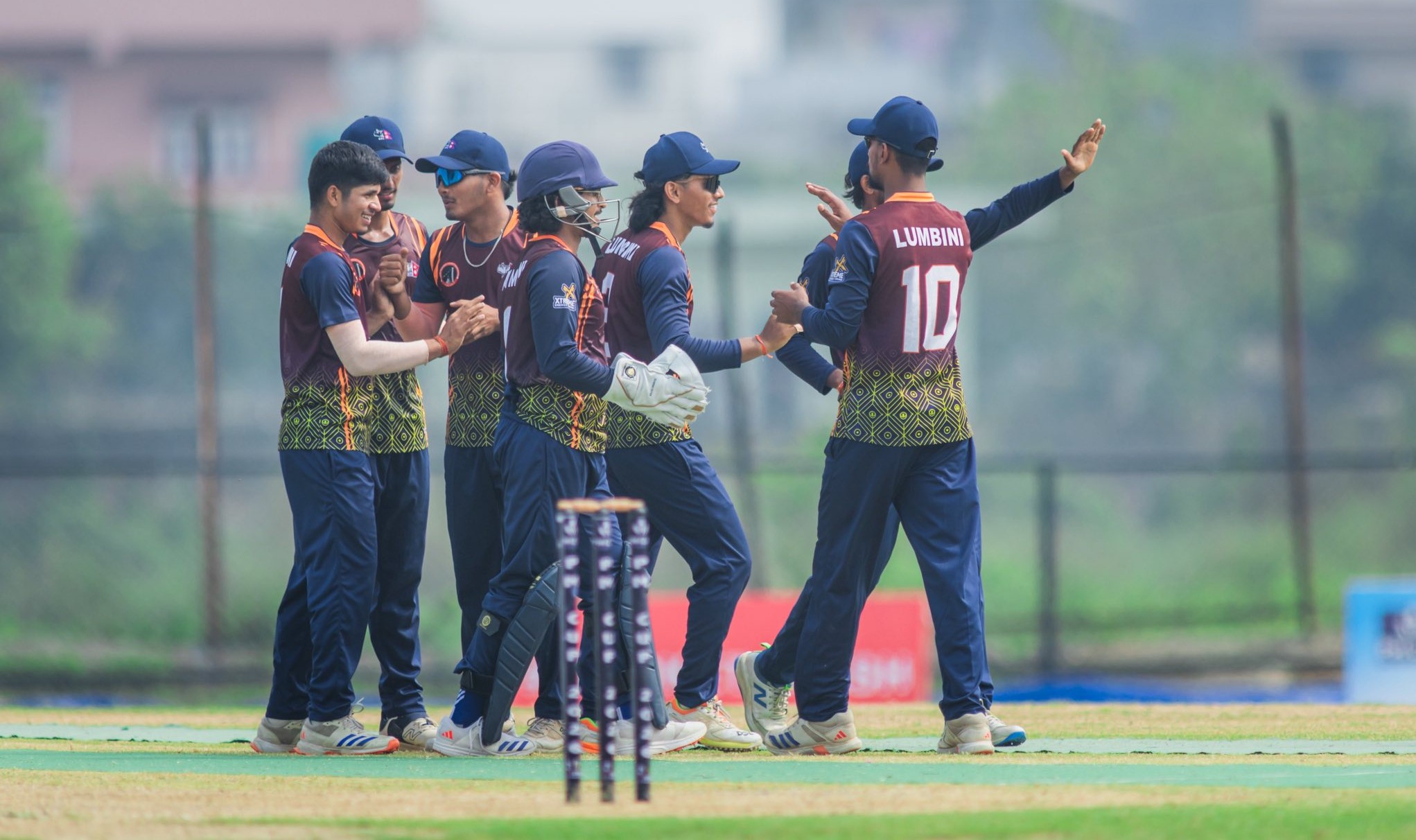
LUMBINI, NEPAL – Near the Maya Devi Temple, birthplace of the Buddha and a symbol of peace, Lumbini Province secured a hard-fought Super Over win against the powerful APF Club. The PM Cup match started as a low-scoring contest before turning into a tense thriller, ending in a tie-breaker with Lumbini just one run short. Santosh Yadav stood out, dismantling the APF lineup at key moments. **The Super Over Showdown** Both teams scored 124, heightening tension. Lumbini batted first in the tie-breaker, scoring 14 despite losing opener Akash Tripathi for zero. Yadav added 8 runs quickly. Defending 15 runs, Yadav then bowled. He dismissed captain Rohit Paudel for one and then limited Lokesh Bam and Sundeep Jora to a combined five runs. APF closed with 6 runs for 1 wicket. ![](https://bootballer.com/storage/media/posts/ZqfBIT3gBKyBYeZA4WOu25ByEoHx3JgwDScHn3ZE.jpg) **The Collapse and the Comeback** Despite several national players, APF struggled and were all out for 124 in under 40 overs. Abhishek Gautam, batting in the lower order, top-scored with 28. For Lumbini, Ajay Chauhan took 4 wickets for 14 runs. Lumbini’s chase looked easy with Captain Dev Khanal (45) and Akash Tripathi (32) at the crease. Then, they lost their last nine wickets for only 50 runs and struggled to finish. **Shifting the Table** This win moves Lumbini to fifth with five points. APF, usually strong, drops to sixth. Lumbini showed determination and resilience, overcoming tough challenges to win.

Lamichhane’s Seven-Wicket Blitz Crushes Karnali in PM Cup

Lamichhane’s Seven-Wicket Blitz Crushes Karnali in PM Cup

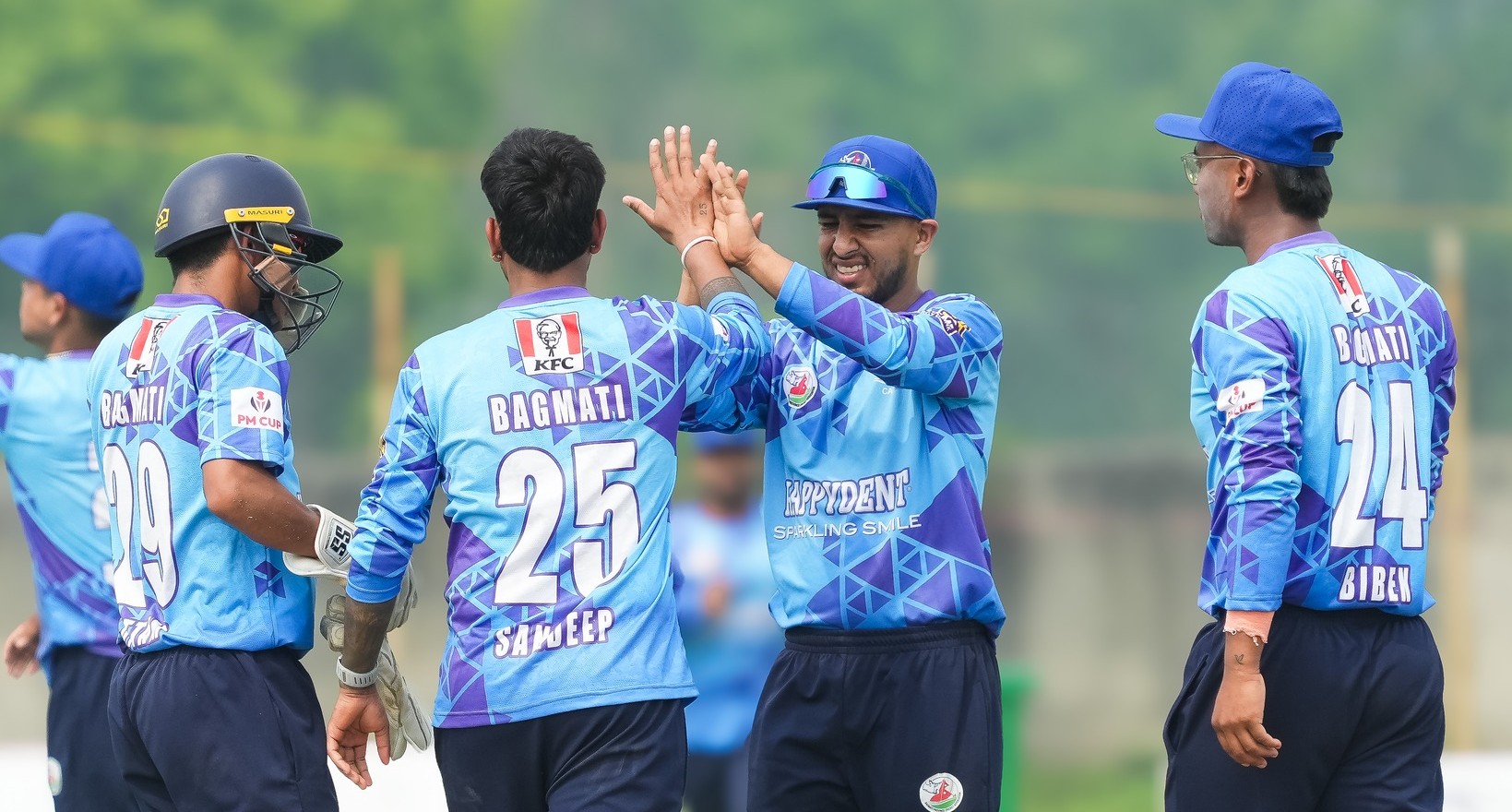
JANAKPUR: On Wednesday, Sandeep Lamichhane took control of the match with a thrilling display, seizing seven wickets and powering Bagmati Province to a stunning 60-run victory over Karnali Province. Building on his initial impact, Lamichhane’s bowling electrified the PM Cup Men’s National Cricket Tournament, restricting Karnali to 120 runs in 25.1 overs as they desperately chased 181. His outstanding 7 for 40 now stands as the tournament’s fourth-best performance, sparking cheers from the crowd. **The Collapse** However, after a spirited start to their chase, Karnali couldn’t handle Lamichhane’s bowling. Nischal Rawal was the only one to put up a fight, scoring 31, while Dinesh Adhikari added 22 and Bipin Shahi made 15. The rest of the middle order fell quickly to the spin attack. As the innings progressed, Lamichhane wasted no time, striking early and maintaining relentless pressure, dismantling most of Karnali’s batting order. Though Rijan Dhakal, Pratish GC, and Subas Khatri took one wicket each, Lamichhane's sensational spell stole the spotlight. Claiming seven wickets, he joins a legendary group of PM Cup performers. ![](https://bootballer.com/storage/media/posts/UXg4zswHX2br4bcFc84U0LusPls2TAQkmwJ7rg0R.jpg) **Bagmati’s Gritty Total** Earlier in the day, Bagmati had a tough start after being sent in to bat. They lost wickets regularly, but Bibek Magar held the innings together with an important 56. Ishan Pandey added 27, and Pawan Thapa scored 22, helping the team reach 180 before being bowled out in the 39th over. Despite Karnali’s captain, Diwan Pun, bowling well, his good work was undone by his team’s batting collapse. In contrast, Bagmati’s bowlers were sharp and took control of the match.

Test Latest Updates Second

Volleyball, Esports and Off Field Updates

Most Viewed Article

Here are all the most viewed articles of the week, carefully curated to bring you the latest insights and trends in the world of sports.